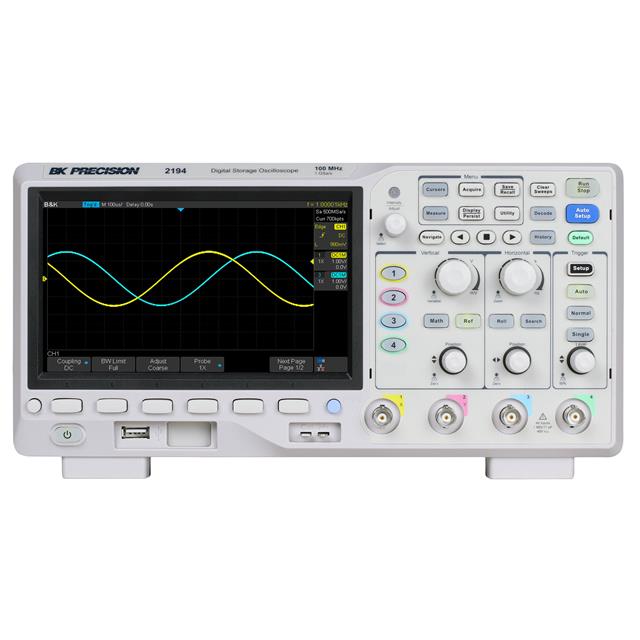
Here’s a good tutorial on exactly what AM transmitter modulation is. It’s far more detailed and has lots more math than is required just to determine if a transmitter’s modulation is within the limits of 100% on negative and 125% on positive peaks.
http://solano.orgfree.com/INTROTELECOM/fre07042_ch03.pdf%20-%20am_fundamentals.pdf
Here’s an example of “overmodulation.”

Note that there’s a short bright line in between the individual cycles. There should never be any time in between cycles that there’s only a line which signifies zero RF signal, commonly called cutoff. That represents greater than 100% negative modulation.
The trace should look like this with a tone modulating the transmitter. Of course, with speech or music, the waveform will be more complex and ever-changing. Still, you want NO bright line segments in the middle.

The little bright line pictured right shows overmodulation beyond 100% on negative peaks. The little oval doesn’t appear on an oscilloscope screen – the author of this article on modulation written for the BDR put the oval in the picture to draw your eye to the relevant spot.
Avoiding exceeding 100% negative modulation is the very most important thing!
The 125% positive peaks legal maximum is a little more involved to see, and unless your transmitter is capable of more than 125% modulation (many aren’t) is a lesser concern.
To check for positive peaks, you just measure based on the little square divisions on the oscilloscope screen. Rather than have me repeat the contents of an article that an engineer wrote for the BDR, please take a look at this quick-read tutorial:
https://www.thebdr.net/measuring-am-modulation/
Please note that down well into the article the author talks about trapezoidal modulation displays and shows some oscilloscope screen picture of that method. For this application it’s not needed, and it’s lots more work to set up.
When you look at an oscilloscope screen of just the unmodulated carrier (no audio) you should see something like this:

Typically the output control on the last audio processor in the chain is adjusted in order to have the loudest possible signal consistent with not exceeding 100% negative or 125% positive modulation peaks.
Inexpensive used oscilloscopes are all over eBay. Something in the $100 range should be more than adequate.
To see the AM signal, connect a few feet of wire to the “hot” input terminal of the oscilloscope, and connect a 2.5 millihenry RF choke across the “hot” and “ground” input terminals. The RF choke keeps the radio wave in the air from going to “ground” at the oscilloscope’s input, but does let the hum and buzz from the electric wiring in the room go to ground and disappear from the oscilloscope screen.

If you can’t get a big enough picture on the screen, make the wire longer, and get it closer to the transmitter. 2.5 millihenry RF chokes look like this:
They’re typically about an inch long.
Many AM transmitters have “Sample ports” into which an oscilloscope probe or a coaxial connector can be inserted. The beauty of the “wires and an RF choke” method is that it takes the RF signal right out of the air, not requiring any connection into the transmitter.
____________________________________________________
Determining the power of an AM station:
Virtually all AM stations are licensed for determining the power by reading the antenna base current meter (or the common point ammeter if the station is using a directional antenna).
By squaring the base or common point ammeter reading and multiplying that number by the antenna base resistance (or the common point resistance if the station is using a directional antenna) the station’s operating power can be determined.
It’s “Ohm’s law.” Power equals current squared times resistance.
Determining the power of an FM station:
Virtually all FM transmitters initially determine power by multiplying the voltage of the last amplifier stage by the current of the last amplifier stage, then multiplying that answer by the manufacturer’s stated efficiency.
Example: 4000 volts times 2.1 amperes is 8,400 watts (of power going into the final or last amplifier stage). Now, multiplying the 8,400 watts of power that goes into the final or last amplifier stage by the transmitter’s efficiency, which we’ll take for our example as being 72%, gives us 8,400 times .72 for a transmitter power output of 6,048 watts. Typically, the FM transmitter power is determined this way, then the transmitter’s power output is set with a screwdriver adjustment inside the transmitter to agree with this computation.